ABM Content Strategy
 Floryn
  Backbase
  Insify
  Mollie
 - Most ABM content strategies depend entirely on outbound distribution. That makes them expensive to maintain and impossible to scale beyond your ad budget.
- Segment-cluster architecture lets you build content that accounts discover organically, through the exact searches they're already making.
- The Minimum Viable Cluster (8-10 pieces per segment) gives you full-funnel coverage without the years-long content calendar.
There are two versions of ABM content strategy being practiced today. One works. The other burns budget.
Version 1: Outbound ABM content. You create personalized decks, custom landing pages, one-off case studies, and bespoke assets for named accounts. You distribute them through LinkedIn ads, direct mail, email sequences, and sales outreach. This can work, but it’s expensive per account, it stops generating pipeline the moment you stop spending, and it doesn’t compound. Every new account requires new custom content and new distribution spend.
Version 2: Organic ABM content. You build content architectures organized by segment, targeting the exact searches your best accounts are already making. This content compounds. It generates pipeline while you sleep. And it scales across every account in a segment, not one account at a time.
This chapter is about Version 2.
Why most ABM content strategies fail to scale
Section titled “Why most ABM content strategies fail to scale”The standard ABM content playbook looks like this: identify target accounts, research their pain points, create personalized content, distribute through paid channels. Repeat for each account.
The problem isn’t the personalization. It’s the distribution model. When every piece of content requires paid distribution to reach its audience, you’ve built a content strategy with a recurring cost floor. Cut the ad budget, and pipeline dries up.
The deeper problem is that outbound ABM content only reaches accounts you already know about. It can’t surface demand from accounts you haven’t identified yet. And in most B2B markets, the accounts actively searching for your solution category outnumber the ones on your named account list.
The segment-cluster model
Section titled “The segment-cluster model”ABM SEO’s approach to content strategy starts from a different premise: organize content by the segments that matter to your business, not by topic categories or keyword volume.
This means every piece of content is built for a specific type of buyer (a segment), mapped to a specific stage of their buying journey, and structured to be discoverable through the searches that segment is already making.
The building blocks:
1. Segments come from your CRM, not keyword tools.
The most common ABM content mistake is starting with keyword research. You end up chasing volume, building content for audiences that don’t convert, and wondering why traffic goes up but pipeline doesn’t.
Instead, start with your CRM data. The underlying principle is context-first SEO: the context determines the content, not the other way around. Pull closed-won deals sourced by organic. Segment by industry, company size, or use case. Look for concentrations. The segments that already convert from organic traffic are your starting point, because the market has already validated them.
2. Each segment gets a content cluster, not a landing page.
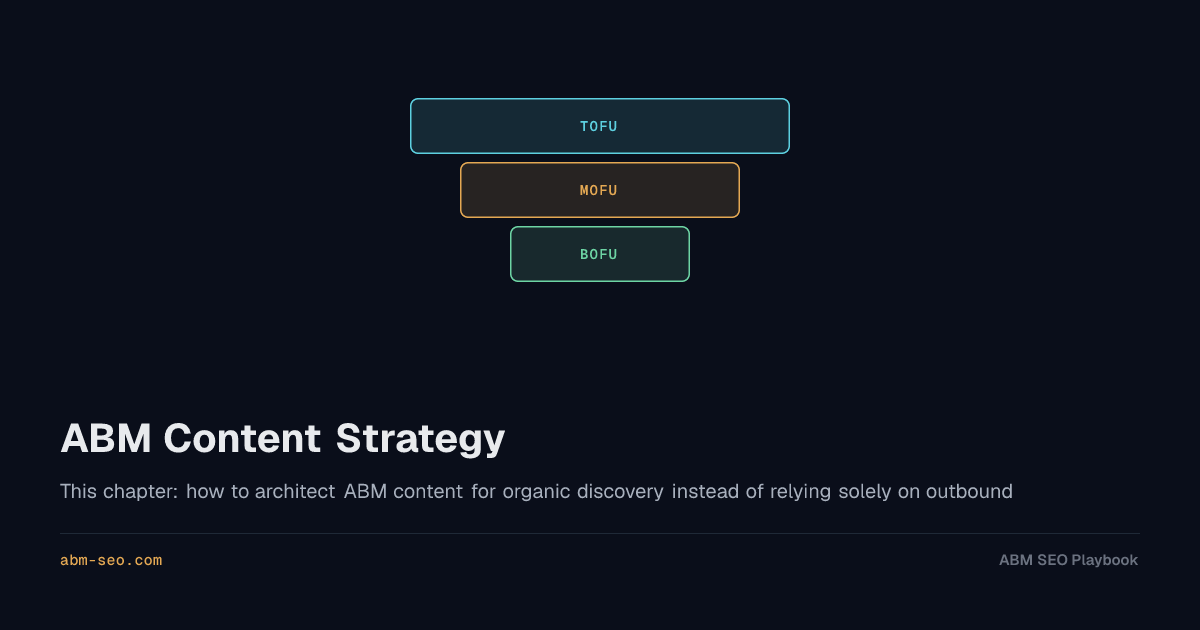
A single landing page targeting a segment isn’t a strategy. It’s a bet on one keyword. A content cluster gives you coverage across the entire buying journey for that segment: awareness-stage content for people who don’t know they need you yet, consideration-stage content for people evaluating approaches, and decision-stage content for people ready to buy.
The Minimum Viable Cluster defines this precisely: 8-10 pieces per segment, consisting of a landing page, a pillar page, and funnel-stage content across bottom, mid, and top-of-funnel.
3. Internal linking creates topical authority.
Ten interlinked pages about a specific segment signal to search engines that you have genuine depth on that topic. A scattered collection of blog posts about various industries does not. The cluster architecture isn’t just organizational. It’s an SEO mechanism. The process for building and auditing those links is in Internal Linking Strategy.
How this differs from traditional B2B content strategy
Section titled “How this differs from traditional B2B content strategy”Traditional B2B content strategy optimizes for reach: create content around high-volume keywords, attract as many visitors as possible, and filter for quality through lead scoring.
ABM content strategy optimizes for relevance: create content for specific buyer segments, attract fewer but better-qualified visitors, and let the content itself pre-qualify the audience.
The practical difference shows up in three places:
Keyword selection. Traditional content strategy starts with volume. ABM content strategy starts with CRM-validated segments and then finds the keywords those segments actually search for. A keyword with 200 monthly searches that attracts enterprise procurement teams in your target vertical is worth more than a keyword with 10,000 searches that attracts students and competitors. The context-first approach explains the mechanism: the same keyword can serve completely different humans, and context is the variable that determines whether the page converts.
Content architecture. Traditional content strategy organizes by topic (all your “what is” articles in one section, all your case studies in another). ABM content strategy organizes by segment, so a CMO visiting your site sees content framed for their concerns, while an operations leader sees content framed for theirs. Same methodology, different entry points.
Success metrics. Traditional content strategy measures traffic, rankings, and MQLs. ABM content strategy measures pipeline contribution by segment: how many qualified opportunities came from organic traffic in Segment A versus Segment B, and what’s the revenue per cluster.
Building your first cluster
Section titled “Building your first cluster”The sequence matters. Most teams try to build content across multiple segments simultaneously and end up with thin coverage everywhere and depth nowhere.
Build vertical-first. Complete one full cluster for your highest-priority segment before expanding. The reasons are practical:
- You learn what the production process actually looks like (it’s slower than you think)
- You get performance data from one complete cluster before committing resources to the next
- You build genuine topical authority in one area instead of shallow coverage across many
The Content Matrix helps you plan and track this:
| Landing Page | Pillar Page | Bottom-Funnel | Mid-Funnel | Top-Funnel | |
|---|---|---|---|---|---|
| Priority Segment | |||||
| Segment 2 | |||||
| Segment 3 |
After the first cluster is live and generating data, expand horizontally: build landing pages and pillar pages across your next segments, then progressively deepen each cluster based on what the performance data tells you.
What to build at each funnel stage
Section titled “What to build at each funnel stage”Each piece in the cluster serves a specific role. Get the roles wrong, and you’ll have content that ranks but doesn’t convert, or content that converts but never gets found.
Bottom-funnel (2-3 pieces): Comparison pages, alternative pages, segment-specific case studies, ROI calculators. These target buyers who know their problem, know the solution category, and are actively evaluating. The keywords here tend to have lower volume but the highest CPC, because they’re closest to a buying decision.
Client example: fintech payments company. CRM analysis revealed that automotive payment solutions businesses were already converting from organic, without any dedicated content targeting that segment. They were finding the site through generic payment processing pages and converting anyway.
That’s one of the strongest signals you can find: unintentional traction.
I built bottom-funnel pages addressing the specific pain points automotive payment companies face: multi-location reconciliation, fleet billing complexity, dealer network payment flows. The cluster started generating qualified leads within the first quarter.
Mid-funnel (2-3 pieces): How-to guides, evaluation frameworks, best practices for the specific use case. These target buyers who know they have a problem but are still figuring out how to solve it. The keywords here tend to have moderate volume and commercial intent.
Top-funnel (2-3 pieces): Industry trends, educational explainers, problem-awareness content. These target people who don’t yet know they need your product but are searching around the edges of the problem. Higher volume keywords, informational intent, lower direct conversion rate, but they build the audience that eventually flows into mid and bottom-funnel content.
The cluster model means you’re not choosing between brand awareness and pipeline generation. You’re building a content architecture that does both, for each segment independently.
Content that compounds versus content that expires
Section titled “Content that compounds versus content that expires”The most important property of organic ABM content: it compounds. A landing page published for your payments segment in March generates traffic in April, May, and every month after. An outbound email sequence to 50 named accounts in the payments segment generates responses during the campaign window, then stops.
This compounding effect means that the economics of organic ABM content improve over time. The cost per lead from organic content drops as the content matures and builds authority. The cost per lead from outbound content stays flat (or increases as audiences fatigue).
That said, organic ABM content takes longer to produce results than outbound. Expect 3-6 months before a new cluster starts generating meaningful organic traffic, and 6-12 months before it reaches steady state. This is why the playbook recommends running outbound ABM programs in parallel with organic cluster builds, then progressively shifting budget as organic coverage matures.
Connecting content to pipeline
Section titled “Connecting content to pipeline”Content that generates traffic but can’t be connected to pipeline is an expense, not an investment. Every piece in the cluster should have a clear path to a measurable business outcome.
The MQL Prediction Model provides the framework for this: given the search volume targeting a segment, estimated organic CTR, and segment-specific conversion rates, you can forecast how many marketing-qualified leads a cluster will generate per month at steady state.
This forecast does three things:
-
Justifies the investment. When you can tell leadership “this cluster will generate X MQLs per month by month 9,” the content program becomes a business case, not a content calendar.
-
Sets realistic expectations. The model produces conservative, baseline, and optimistic scenarios. No one is surprised when results take time, because the timeline was modeled upfront.
-
Creates accountability. If a cluster isn’t performing to the model’s projections after a reasonable period, you investigate why: is it a traffic problem (content isn’t ranking), a conversion problem (traffic isn’t converting), or a model problem (the assumptions were wrong)?
What this approach doesn’t solve
Section titled “What this approach doesn’t solve”Organic ABM content is not a replacement for outbound. It’s a different channel with different economics.
It doesn’t work for one-off deals. If you’re pursuing a single named account and need to close them this quarter, build a custom deck and get on the phone. Organic content is a segment-level play, not an account-level play. It pays off when you’re targeting a category of accounts, not one specific company.
It doesn’t produce results in weeks. The compounding effect is real, but so is the ramp time. If leadership expects pipeline contribution from content within 30 days, set that expectation before you start. The honest timeline is 3-6 months to meaningful traffic, 6-12 months to steady-state pipeline.
It requires content depth you can’t fake. Thin content doesn’t build topical authority. Each piece in the cluster needs to be genuinely useful for the segment it targets, and when the same concept appears in multiple segment clusters, the pages must be genuinely differentiated, not cosmetic variants with swapped industry terms. If your team can’t produce that depth (because they lack domain knowledge, or because they’re stretched across too many priorities), the cluster won’t perform. One strong cluster beats three weak ones.
It assumes your segments are real. If the segments come from a brainstorm instead of CRM data, the content might attract traffic that doesn’t convert. The CRM-driven discovery process exists specifically to prevent this.
Where to start
Section titled “Where to start”If you’re building an ABM content strategy from scratch:
-
Run segment discovery on your CRM data using the CRM-driven process. Identify your top 2-3 segments by revenue concentration and organic conversion signal.
-
Pick one segment to build first. Choose the one with the strongest CRM signal and the most accessible keyword landscape (lower competition, clear search intent).
-
Build the Minimum Viable Cluster for that segment using the Content Cluster Architecture: landing page, pillar page, and 6-8 funnel-stage pieces.
-
Forecast pipeline using the MQL Prediction Model so you know what to expect and when.
-
Measure by segment, not by page. Track pipeline contribution per cluster, not traffic per post. The cluster is the unit of measurement.
Then expand to the next segment and repeat.
For the complete methodology from segment discovery through forecasting, see the playbook overview.
Get notified when new chapters publish
Summarize with AI